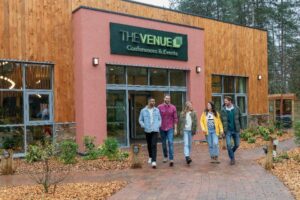


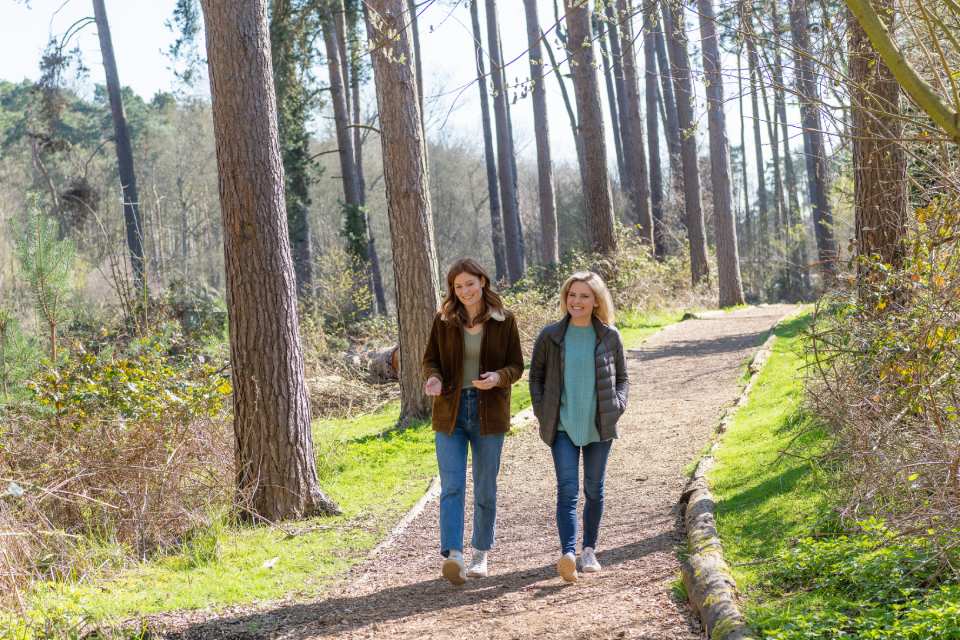
As hybrid work continues to blur the boundaries between personal and professional life, people want to be spending more time outdoors with their colleagues. We also want work events to deliver what the day job often cannot: time outdoors…
New research from Center Parcs Conferences & Events finds that almost one-third (31%) of people spend no time at all outside with their colleagues, while more than half (53%) spend less than one hour per month.
The findings highlight a clear disconnect between what employees want and what they are currently experiencing. While 63% of employees are interested in events in natural environments, one in four (25%) feel that current work events do not cater to their preferences.
We wish to get away from screens, spending more time outdoors with colleagues
With hybrid working driving more meetings online, over two-thirds (68%) of employees say they want to unplug from screens during corporate events, reflecting a shift toward in-person experiences that support wellbeing as well as productivity.
“People have grown tired of ‘tick-box’ events in stuffy conference rooms with presentation-heavy agendas. They’re looking for intentional experiences that help them reset and reconnect with their colleagues,” said Julia Green, Head of Corporate Events at Center Parcs Conferences & Events.
“Our research shows that on average, employees spend just over two hours a month (122 minutes) outside with their colleagues, across both office and non-office roles alike. That’s roughly the same amount of time most people spend in a single meeting. It’s no wonder they are craving time outdoors away from traditional event settings.”
Appetite for spending time outdoors with colleagues varies by region
Spending time outdoors with colleagues supports wellbeing, strengthens team connections and helps people refocus, benefits that boost both productivity and staff retention. This appetite for “touching grass” is especially strong in urban areas, with workers in the West Midlands spending the most time outside with colleagues, averaging 153 minutes per month (over two and a half hours), followed by Londoners at 133 minutes.
The data shows that this is higher than in regions such as Yorkshire & The Humber (89 minutes) and Northern Ireland (84 minutes), suggesting employees in densely populated areas are actively carving out moments outside during their working day.
Employees in these urban regions also express the strongest desire for screen breaks, with 75% of Londoners and 73% of West Midlands workers saying they want time away from screen at work events, highlighting demand for engaging, in-person experiences that go beyond typical corporate settings.
Generational differences also follow a similar pattern. Gen Z shows the strongest preference for work events in natural environments of any age group, yet they spend the least time outdoors with colleagues (on average 105 minutes per month). This is notably lower than Generation X (128 minutes) and Millennials (124 minutes).
“Center Parcs has always championed the power of nature, and we’re seeing huge demand for corporate team building days in our rich forest surroundings,” added Julia. “These experiences move beyond traditional icebreakers, offering shared challenges that invite genuine collaboration across the entire workforce, and are filled with meaningful moments of reflection.
“When people step outside their usual setting and into nature together, it gives them the space to think differently, speak more openly, and build authentic connections that feel long-lasting. We see firsthand delegates leaving feeling more relaxed and revitalised, and it’s encouraging to see this supported by hard data.”
Center Parcs’ research highlights more than just a simple preference, it shows a shift in what employees actually value from work events. For organisers, this is an opportunity to create experiences that are restorative, collaborative and memorable, outside the confines of the typical office or conference room. As hybrid work reshapes how teams meet, the events that are most successful will be the ones that give people space to recharge, reconnect and return to work inspired.
This survey was conducted by Mortar in January 2026 among 2,000 employed adults in the UK.