

To be successful during your interview and to make the very best impression lies in you being fully prepared. Conducting and leveraging a “Personal SWOT” is a great way to prepare and be interview ready says Lindsay Taylor, Director of Your Excellency Limited, one of the world’s leading learning and development specialists for EAs, PAs and VAs…
This favourite quote of Lindsay’s sums it up nicely: “Failing to plan is planning to fail”.
What is a Personal SWOT?
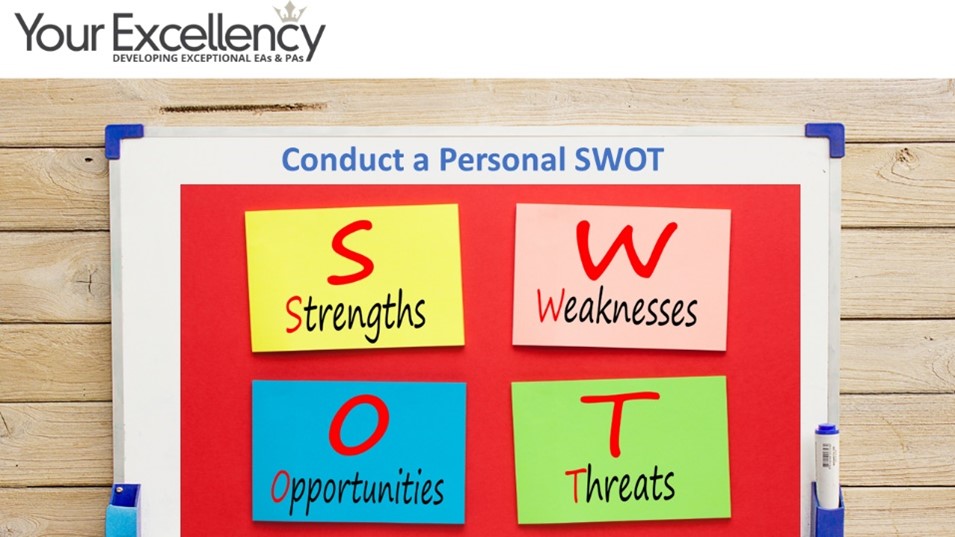
You’ve probably heard of SWOT analysis. SWOT is an acronym and it stands for Strengths, Weaknesses, Opportunities and Threats. A SWOT analysis is normally conducted on an industry or organisational level to help a business identify their strategy.
A personal SWOT is similar in that you are identifying Strengths, Weaknesses, Opportunities and Threats – this time though it’s in relation to YOU – so on a personal level.
It’s a fantastic way of gaining a snapshot of “you” at any one moment in time. The resulting information can be hugely insightful and incredibly useful for you to prepare and know that you are interview ready.
How often should I conduct a Personal SWOT?
It is good practice to conduct a regular personal SWOT. This is not a “one-off exercise”. Change is constant and I’d recommend conducting a Personal SWOT as a check in with yourself every 2-3 months – or more frequently if you know there have been noticeable or significant changes in your life. And, of course, the focus for this article is on conducting a Personal SWOT in preparation for your interview.
What considerations do I need to make?
The exercise should take about 20 minutes tops and I recommend you do it in “one go” without any distractions. This way you’re able to remain focussed on answering the questions as one complete package – because one question posed may impact another. Pick a time and place where you aren’t going to be interrupted or disrupted. Think of this as “quality YOU time” – an investment in yourself and an absolute necessity for your interview prep. Grab a cup of tea or coffee… plus a big piece of paper and if you’re a visual learner some coloured pens.
Separate your paper into 4 squares labelled up S, W, O and T. If you’re visual you can use different coloured pens that represent the quadrants here. So you may use Red for Strengths or indeed Red for Weaknesses – whatever works for you. There are psychological benefits to writing things down. You’ve thought of something to write so from your thoughts in your head, you put that down on paper, you add movement by writing it down and then you’re reading it as your write so reinforcing the words – it’s a multi-sensory learning experience.
Date your Personal SWOT too so when you look at it again you know when you did it and can compare it to your new or subsequent SWOTs.
When you’re answering a Personal SWOT question jot down the first things that come into your mind. Don’t overthink a question and if a question doesn’t sound right, look right or feel right just move on to the next question.
Consider yourself as a “whole person” – by that I mean not just you at work. There are things that you will have achieved outside of work that you will be really proud of – perhaps it’s raising a happy, healthy child or running a marathon. Your achievements (often outside of work) are gained by drawing on strengths that are part and parcel of YOU so it’s important to identify those strengths in your Strengths Box.
The Strengths Box in your personal SWOT
The strengths box can be invaluable for writing the “personal statement” section of your CV. It can also give you a boost of self-confidence when you identify “I’m really good at event management” or “I’m really good at persuading others” – its empowering to take ownership of your strengths.
I do absolutely appreciate that some people struggle with identifying their strengths – we can be really good at giving ourselves “negative feedback” but feel like we’re bragging or being big-headed when we say “I’m really good at ….something”. But this isn’t bragging -it’s stating fact and being proud that you good at something. So, when an interviewer asks what your particular strengths are, share them! For each of your strengths you’ve identified have evidence ready at interview. So, if one of your strengths is event management for example, you may say – “I organised last month’s sales conference for 200 people and this was evidenced by the fact that 90% of the feedback was a 5 star rating”.
The Weakness Box
The Weaknesses Box is an interesting one. When I ask the question “by eliminating your weaknesses could these lead to opportunities for you?” – there is one answer which is “yes”. However, this question is followed up with “are there weaknesses that you’re comfortable with that you don’t necessarily want to change?”. So, in my weaknesses box I would put “finance” and “maths” or “numerical work” as my weaknesses. I jokingly share with people that once I’ve run out of counting on my fingers and toes I’m out! I exaggerate I know – I could improve my finance and mathematic prowess and knowledge however, I get by just fine and it hasn’t held me back from achieving. I don’t get excited by figures and numbers so I wouldn’t be motivated to do this – at the moment anyway.
It’s worth noting that there will be weaknesses that are gaps in your skillsets or knowledge and will be holding you back from being the best version of YOU and which you could focus on. Ultimately you want to see these Weaknesses as Opportunities and upskill to such a degree that you move these to your Strengths Box.
For the weaknesses I do want to change – to ensure they lead to opportunities – I need to give myself great feedback as to what to do next. So another weakness for me would be the use of Excel so I’m starting an online course next month to become better at using this.
If an interviewer asks you to identify one of your weaknesses you can still turn this into a positive. “I’m not particularly great at using Excel however I am starting an Excel course next month so I can improve my skills”.

Strengths
Use the PAS model below:
- P = Personality: What personality traits do you consider to be your strengths? What tells you that? What evidence do you have to support this? What personality traits do others consider to be your strengths? What feedback/comments have you had from others?
- A = Attributes: What attributes and skills do you consider to be your strengths? What tells you that? What evidence do you have to support this? What attributes and skills do others consider to be your strengths? What feedback/comments have you had from others?
- S = Successes: What successes do you have? What achievements are you most proud of? What strengths have you had to draw on to achieve these things?What networks are you part of? What connections do you have with influential people?
Weaknesses
- Consider your weaknesses as areas that potentially you can develop – they are opportunities for you to better yourself.
- What personality traits do you consider to be your weaknesses? What tells you that? What evidence do you have to support this?
- What personality traits do others consider to be your weaknesses? Do you have personality traits that hold you back?
- What attributes and skills do you consider to be your weaknesses? What tells you that
- What attributes and skills do others consider to be your weaknesses?
- What tasks do you avoid because you don’t feel confident doing them?
- How confident are you in regard to your education and training – are there any weaknesses here?
- Do you have any “negative” habits?
Opportunities
- What networking events, educational classes, training and conferences can you attend? How could you find out about these?
- Can you cover for someone on leave or make yourself available to run a project or learn new skills?
- Do your identified strengths open up any possibilities and opportunities?
- By eliminating your weaknesses, does this open up opportunities and possibilities for you?
- Which weaknesses do you want (or need) to eliminate to make them opportunities
- Which weaknesses are you comfortable with?
- Is there any new technology that you can take advantage of?
- Are there any trends in your company, sector or profession that you can take advantage of?
- Is there a need in your company, industry or profession that no-one is filling?
Threats
- What obstacles or barriers do you currently face that could be threatening your success
- Does changing technology threaten your position?
- Could any of your weaknesses lead to threats?
PA Life Club members CAN take advantage of discounts on Your Excellency’s selected offerings including:
The industry-first and much acclaimed Mini MBA for Senior & Executive Assistants Programme and The Essential PA Programme incorporating the only Ofqual registered qualification to use “PA” in its title.
–> Join PA Life Club for free and enjoy exclusive member benefits, such as the great Partner Offers by Your Excellency above and invitations to our events, networking and a free peer-to-peer mentoring programme.