


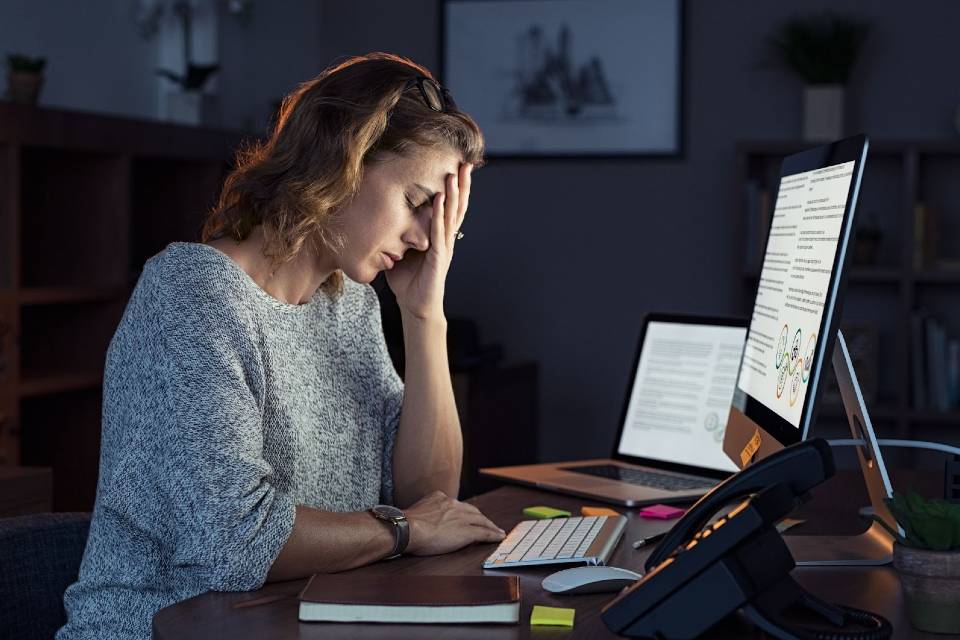
Over two fifths (44%) of UK office workers report sometimes or always experiencing feeling burnt out while at work, a new nationwide survey has revealed.
The Digital Detox survey, conducted by Just Eat for Business, uncovers workers’ habits towards breaks and computer use, focusing on screen time. The study also includes expert comments on the mental impact of skipping breaks, and offers advice on how to combat it. The survey included responses from over 200 UK workers, and were segmented by job role (business owners/C-suite, management team and executive).
When asked whether they’ve ever felt burnout – described as ‘a state of physical and mental exhaustion which can occur when one experiences chronic workplace stress’, 44% of UK workers responded affirmatively, suggesting two fifths of workers need a break from work.
Workers’ experiences of burnout differs from role to role, with those working in management accounting for the highest proportion (46%) of those who’ve suffered from the ‘occupational phenomenon’ (defined by the World Health Organization).
While those in management positions account for the highest proportion of workers who’ve experienced burnout overall, those working at an executive level have seen the biggest increase of late – reporting a 21% rise in feeling burnt out over the last year.
The survey also asked workers how often they find themselves skipping breaks – such as lunch or hourly screen breaks – to draw parallels between work habits and feeling burnt out.
This revealed that over a third (36%) of workers are skipping more lunch breaks now than last year, while 1 in 5 workers check platforms like Slack every hour – even when not at work.
There appears to be a correlation between those who skip breaks and those who feel burnt out, with 73% of workers who report feeling burnout also admitting they don’t take a break until lunch, while 46% don’t stop looking at their screen until the end of the working day.
And with work from home advice now at employers’ discretion, the focus is on them to encourage regular screen breaks to avoid these mental health repercussions.
Dr Anneli Gascoyne, Associate Professor in Occupational Psychology at Goldsmiths University, commented on the impact of excessive screen time, both at work and home: “When we’re focusing our attention on our screens, we’re using physical and psychological resources (including energy, motivation and concentration) even if we don’t realise it. Like batteries, these resources aren’t in limitless supply, and need to be recharged.
“Yet, we often find ourselves taking breaks from our computer screens by scrolling on another screen, via our phones, and then in the evening we take a break from our phones by watching telly (or perhaps attempting both at the same time!)
“These aren’t the restorative activities we might think they are. They might feel pretty mindless, but they’re still hooking our attention. And we then find that, when we put our head on the pillow at night, all the concerns and ideas of the day start to flood into our awareness, when we should be sleeping.”
Dr Brad McKenna (University of East Anglia) and Dr Wenjie Cai (University of Greenwich), offer some solutions that both employers could implement in order to promote breaks, and reduce screen time: “Employers could create new organisational policies and implementations such as requiring digital wellbeing to be integrated into operational strategies. These could be pitched as ‘take a break’ strategies which should be supported by senior management and implemented throughout the organisation.
“There could also be messages put into company IT systems, for example, a message might pop up saying “remember to take a break” and companies could consider alternative ways of working away from the screen.”
Rosie Hyam, People Partner at Just Eat for Business adds to the expert commentary, saying: “Regardless of how teams are working – whether it’s in the office, at home, or a hybrid solution – it’s essential to take regular breaks. Without these, it’s not surprising that so many workers are feeling more burnt out than before.
“Given the emphasis currently being placed on health and wellbeing, it’s important that employers and employees prioritise sustainable and healthy working habits – including taking more regular screen breaks, and setting time aside to socialise with colleagues.
“Organisations may want to consider organising regular events that encourage time away from screens, and offer opportunities for team bonding – such as weekly catered in-office lunches, or food deliveries for at-home workers.”
Other key findings of the survey included how often workers put in overtime per week, and why employees may feel pressured to check work notifications outside of office hours.